Retention vs. Acquisition
Retaining customers costs 5-7x less than acquiring new ones. Learn when to prioritize each, how to measure both, and the leaky bucket trap to avoid.
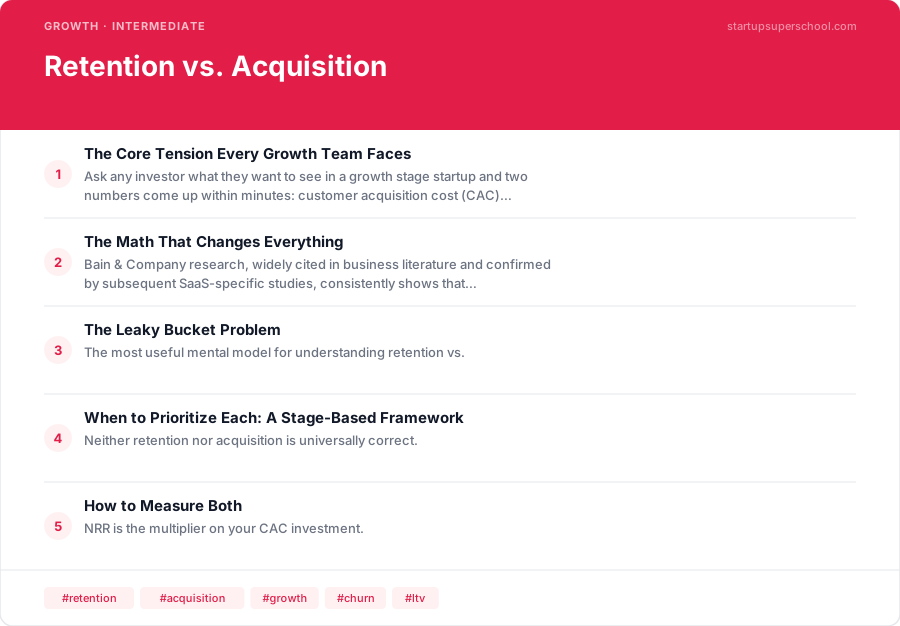
The Core Tension Every Growth Team Faces
Ask any investor what they want to see in a growth stage startup and two numbers come up within minutes: customer acquisition cost (CAC) and lifetime value (LTV). But the relationship between these two metrics hides a more fundamental strategic question that many founders answer incorrectly: should you be spending more to bring new customers in, or more to keep the ones you have?
The answer changes depending on your stage, your churn rate, and the unit economics of your specific business. Get it right and growth compounds. Get it wrong and you spend years - and millions - running on a treadmill.
The Math That Changes Everything
Bain & Company research, widely cited in business literature and confirmed by subsequent SaaS-specific studies, consistently shows that retaining an existing customer costs 5–7x less than acquiring a new one. The underlying reasons are structural:
- No discovery cost: existing customers already know your product exists
- No sales cycle: re-engaging an existing user skips weeks of pipeline work
- Lower support overhead: customers who already know the product generate fewer tickets per dollar of revenue
- Higher conversion probability: an existing customer’s probability of buying an upsell is 60–70%; a new prospect converts at 5–20%
For SaaS specifically, the math compounds over contract length. A customer paying $500/month who stays for 24 months generates $12,000 in revenue. If your CAC is $2,000, the LTV:CAC ratio is 6x - healthy. If that same customer churns at month 6, the ratio drops to 1.5x - you barely broke even.
The Leaky Bucket Problem
The most useful mental model for understanding retention vs. acquisition is the leaky bucket.
Imagine your business is a bucket. New customers are water poured in from the top (acquisition). Churned customers are water draining through holes at the bottom (churn). The goal is to fill the bucket.
The mistake most growth teams make is focusing exclusively on the top. They increase ad spend, hire more SDRs, run more campaigns - and pour water in faster. But if the holes in the bottom are large enough, the bucket never fills. You might even be profitable on a unit economics basis per customer acquired, while still losing ground overall because churn outpaces acquisition.
A numerical example:
| Month | New Customers | Churned | Net Growth | Total Base |
|---|---|---|---|---|
| 1 | 100 | 10 (10%) | +90 | 100 |
| 6 | 100 | 55 (10%) | +45 | 578 |
| 12 | 100 | 87 (10%) | +13 | 868 |
| 18 | 100 | 96 (10%) | +4 | 971 |
With 10% monthly churn and 100 new customers per month, the business asymptotes toward ~1,000 customers and never meaningfully exceeds it - no matter how much you spend on acquisition. Cut churn to 5% and the same 100 new customers/month compounds to nearly 2,000 by month 18, and keeps growing.
Plugging the bucket is not a defensive move - it is the highest-ROI growth action available.
When to Prioritize Each: A Stage-Based Framework
Neither retention nor acquisition is universally correct. The right priority depends on your stage.
| Stage | Primary Focus | Secondary Focus | Key Signal |
|---|---|---|---|
| Pre-PMF (0–100 users) | Acquisition (learning) | Qualitative retention conversations | Are users telling others about you? |
| Post-PMF, pre-growth (100–1,000 users) | Retention | Acquisition via referral | NPS > 40, churn < 5%/month |
| Early growth ($1M–$5M ARR) | Both, with retention as foundation | Scale acquisition channels | NRR > 100% before scaling paid |
| Growth ($5M–$20M ARR) | Acquisition at scale | Retention infrastructure | NRR > 110% is the unlock for aggressive CAC |
| Scaling ($20M+ ARR) | Expansion revenue | New segment acquisition | NRR > 120% compounds on existing base |
Pre-PMF: Acquisition Is Learning
Before product-market fit, acquisition is not about scaling - it is about gathering enough diverse users to learn what the product should be. Obsessing over retention at this stage is premature because the product will change substantially based on what you learn.
The right retention signal at this stage is qualitative: are users telling you the product is indispensable? Are they frustrated when it breaks? Are they referring colleagues unprompted? Those are the early signs that retention will be strong once the product stabilizes.
Post-PMF: Retention Becomes the Foundation
Once you have PMF signals - voluntary churn below 5% monthly, NPS above 40, consistent qualitative feedback indicating users would be “very disappointed” without the product - retention becomes the foundation you build acquisition on top of.
Scaling acquisition before retention is solid is the single most common cause of “growth plateau” in Series A and B startups. The company raises $5M, triples the sales and marketing budget, acquires customers fast, and then watches LTV erode as churn climbs because the product and CS infrastructure was not ready.
Growth Stage: Measure Both, Optimize Retention First
At $1M–$5M ARR, the right sequence is:
- Get NRR above 100% (existing customers generating more revenue than they lose to churn)
- Identify the 1–2 acquisition channels producing your best-retained customers (not just cheapest CAC)
- Double down on those channels
- Use NRR as the “permission signal” to increase CAC - if your base is expanding on its own, you can afford to spend more to acquire customers
How to Measure Both
Acquisition Metrics
| Metric | Formula | Target (B2B SaaS) |
|---|---|---|
| Customer Acquisition Cost (CAC) | Total sales + marketing spend / New customers | Varies; LTV should be >3x |
| Payback Period | CAC / Monthly gross profit per customer | <12 months SMB, <18 months enterprise |
| Channel Conversion Rate | Leads / Customers by source | Benchmark against your own history |
| Time to First Value | Days from signup to activation moment | <7 days for SMB SaaS |
Retention Metrics
| Metric | Formula | Target (B2B SaaS) |
|---|---|---|
| Monthly Churn Rate | Churned MRR / Beginning MRR | <1% monthly |
| Net Revenue Retention | (Beginning MRR + Expansion - Churn) / Beginning MRR | >100%; top quartile >120% |
| Cohort Retention (Day 30) | Active users at day 30 / Users acquired in cohort | >50% for SMB, >70% enterprise |
| LTV | ARPU / Monthly churn rate | >3x CAC |
The Relationship Between CAC and NRR
NRR is the multiplier on your CAC investment. If NRR is 120%, a customer paying $1,000/month in year one is worth $1,200 in year two without any upsell effort. That compounds: year three is $1,440, year four is $1,728. Over four years, a 120% NRR customer is worth 78% more than a 100% NRR customer who pays flat.
This is why top SaaS investors value NRR above almost any other metric - it tells them whether the moat is widening or shrinking.
Common Mistakes
Mistake 1: Treating Acquisition as the Only Growth Lever
Many early-stage teams treat “growth” as synonymous with “acquisition.” They track new signups obsessively but have no visibility into cohort retention. By the time poor retention shows up in revenue numbers, the problem is systemic and expensive to fix.
Fix: add a cohort retention table to your weekly dashboard from day one.
Mistake 2: Optimizing Retention Before PMF
The opposite error - obsessing over churn before knowing what the product should be - leads to building features for users who are not your eventual target customer. You improve retention for the wrong cohort and delay finding PMF.
Fix: run retention optimizations only after three consecutive months of stable (not improving - stable) churn below 10%/month. Before that, focus on qualitative learning.
Mistake 3: Using Average Churn Instead of Cohort Churn
Averaging churn across all cohorts masks a critical insight: churn patterns differ dramatically by acquisition channel, plan type, and company size. A product might have 2% monthly churn on average but 8% churn for customers acquired via paid ads and 0.5% churn for enterprise accounts. Average churn leads to the wrong investment decisions.
Fix: always segment churn by cohort, channel, and plan tier.
Mistake 4: Scaling Acquisition with Negative NRR
A business with NRR below 100% is a business that shrinks as it matures. Adding acquisition spend on top of negative NRR creates a treadmill: you must acquire more and more customers each period just to offset the erosion of the existing base.
Fix: do not increase paid acquisition spend significantly until NRR exceeds 100%. Use the period before that threshold to invest in customer success, onboarding, and product improvements that drive expansion.
Key Takeaway
Retention and acquisition are not competing priorities - they are sequential. You build the retention foundation first, then you pour acquisition fuel on top. A business with 120% NRR can afford to spend aggressively on acquisition because each customer compounds in value over time; a business with 80% NRR will shrink no matter how much it spends on ads. The leaky bucket analogy holds at every stage: plug the holes first, then increase the flow. Founders who internalize this sequencing build companies that compound. Those who chase acquisition while ignoring churn find themselves explaining to their board why growth stalled despite record spend.
Frequently Asked Questions
Why is customer retention cheaper than acquisition?
When should an early-stage startup prioritize acquisition over retention?
What is the leaky bucket problem in growth?
What metrics best measure retention vs. acquisition performance?
What is net revenue retention and why do investors care about it?
Create an account to track your progress across all lessons.
Comments
Loading comments...